Bank Reconciliation Automation: 2,500 Transactions in About 5 Minutes
Matching a bank ledger to a statement can eat a whole working day. Here is how I built a reconciliation tool that is fast, transparent and keeps humans in control of the exceptions.
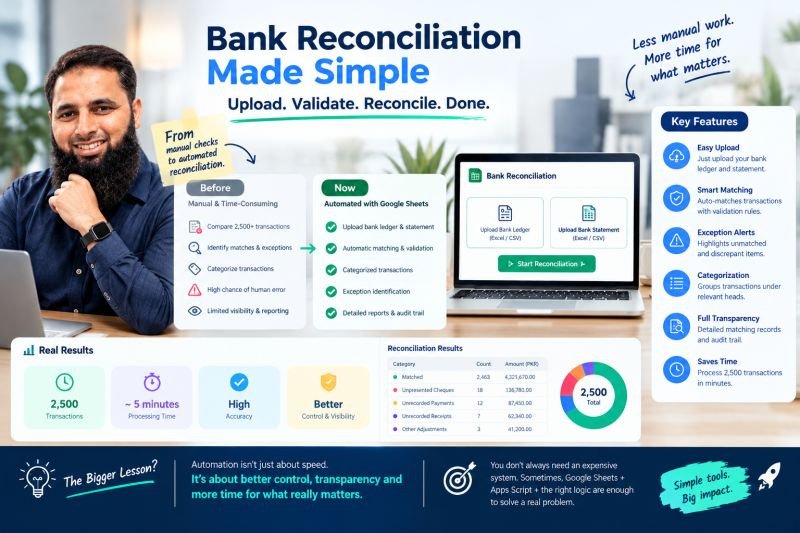
The visual I shared with the original LinkedIn post.
More than matching two lists of numbers
Bank reconciliation is about finding out what matches, what doesn't, and why.
The finance team compared the bank ledger with the bank statement transaction by transaction, then classified each item:
- Unpresented cheques
- Unrecorded payments
- Unrecorded receipts
- Uncredited receipts
With around 2,500 transactions, doing this by hand takes a full working day. It also needs constant attention, invites human error, and makes it hard to review later how something was matched.
What I built
A reconciliation automation that helps match the ledger against the statement:
- Faster: about 2,500 transactions in roughly 5 minutes.
- Transparent: it keeps a record of the matching details, so users can see how a transaction was matched.
- Exception-focused: unmatched transactions are flagged for review.
- Categorized: transactions are grouped under the relevant reconciliation heads.
- Manual matching is available when an automatic match isn't appropriate.
Speed + transparency + control
In finance, speed without control creates another problem. A good reconciliation tool should deliver three things together: speed, transparency and control.
The goal isn't just to finish sooner. It is to give the team time to investigate exceptions and resolve discrepancies, the work that genuinely needs human judgment.
Related work
The same thinking drove my daily bank position automation, which collects statements from email and calculates available funds.
I first shared this on LinkedIn. If you have a similar problem in your own team, connect with me on LinkedIn and let's talk.
Enjoyed this post?
Follow my journey from finance ledgers to one-click automation.